




Posted By: Dr. Usha M Kumar on 14 Sep 2026
A diagnosis of MRKH can bring many questions. Treatment should begin with understanding—not urgency.
Being diagnosed with MRKH syndrome can be an overwhelming experience, particularly for an adolescent or young woman who is learning about her reproductive anatomy for the first time. Questions about menstruation, intimacy, fertility, relationships, and the future may all arise at once.
One of the treatment-related questions patients may eventually ask is: “Can a vagina be created if it has not developed normally?”
In many cases, the answer is yes. A functional vaginal canal can be created through a non-surgical dilation programme or, when appropriate, through reconstructive surgery. The process is known as neovagina creation.
However, treatment is not something that every person with MRKH must undergo. The decision depends on the individual’s anatomy, preferences, emotional readiness, medical needs, and future goals.
For women seeking specialised care in Delhi, Dr. Usha M. Kumar, a gynaecological and robotic surgeon associated with Max Smart Super Speciality Hospital, Saket, is a specialist patients may approach to discuss complex gynaecological and reconstructive surgical options. Her published professional profile documents extensive experience in gynaecology and advanced endoscopic and robotic surgery.
This article explains what MRKH syndrome means, when neovagina creation may be considered, how treatment options differ, and what patients should understand before making a decision.
What Is MRKH Syndrome?
Mayer-Rokitansky-Küster-Hauser syndrome, commonly called MRKH syndrome, is a congenital condition involving the development of the female reproductive tract.
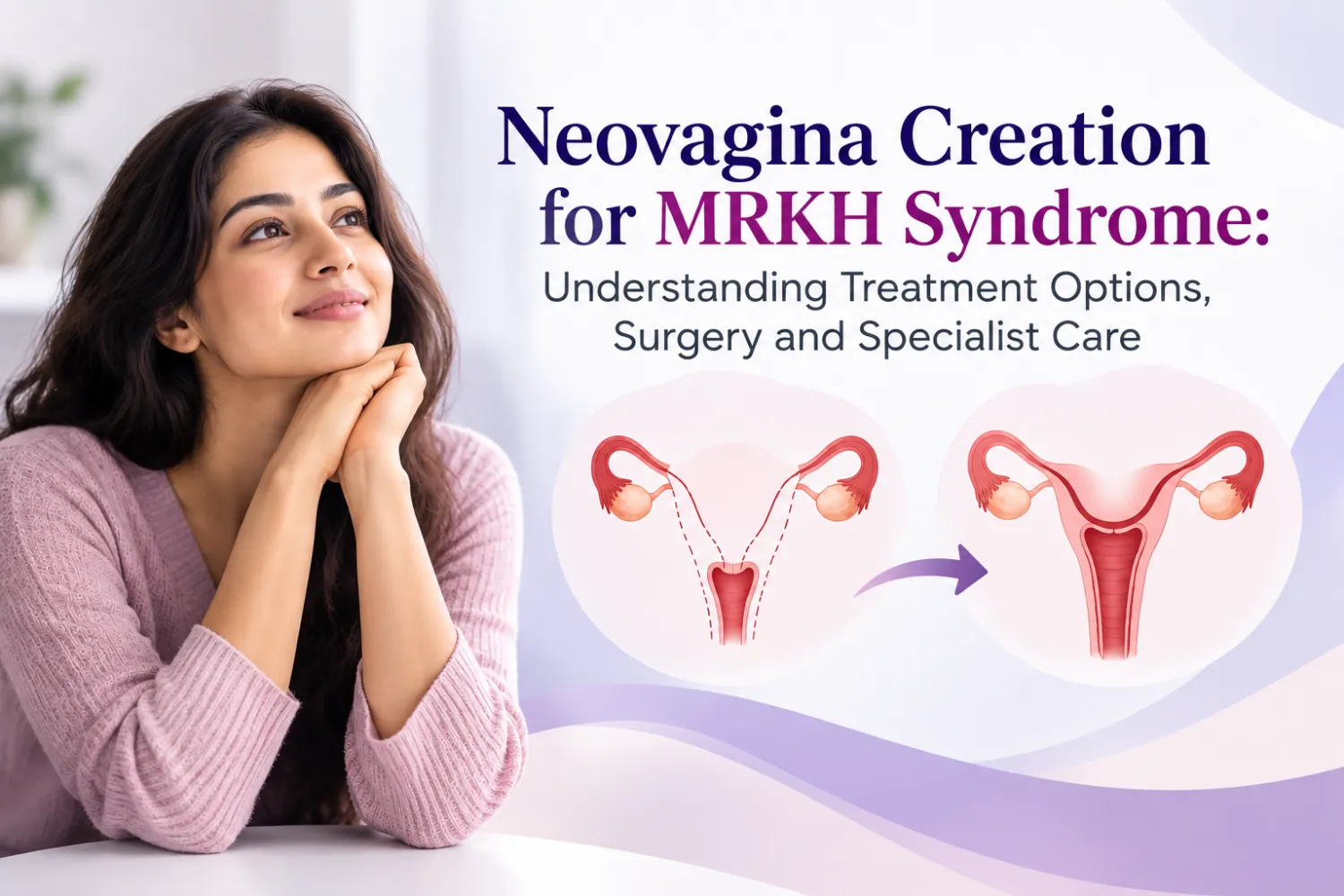
In typical MRKH, the uterus and the upper portion of the vagina are absent or underdeveloped. The ovaries are often present and function normally because they develop from a different embryological origin.
Many individuals with MRKH have typical external genital development and experience normal pubertal changes. The condition is frequently identified during adolescence when menstruation does not begin, a situation known as primary amenorrhoea.
MRKH is not caused by anything a person or their parents did. It is a developmental condition that occurs before birth.
How common is MRKH syndrome?
MRKH, also referred to as Müllerian agenesis, is estimated to occur in approximately 1 in 4,500–5,000 females, according to the American College of Obstetricians and Gynecologists (ACOG).
ACOG
Are there different types of MRKH?
MRKH is often described in two broad forms:
- Type I MRKH: Primarily involves reproductive tract abnormalities.
- Type II MRKH: Involves reproductive tract abnormalities along with associated congenital differences, which may affect the kidneys, skeleton, hearing, or other systems.
Not every patient has associated conditions. Nevertheless, a complete evaluation is important because kidney and skeletal abnormalities can occur alongside Müllerian developmental anomalies.
ACOG
What Symptoms May Lead to an MRKH Diagnosis?
Many patients first seek medical attention because menstruation has not started by the expected age.
Possible signs and associated findings include:
- Primary amenorrhoea
- Absent or underdeveloped uterus
- Shortened or absent upper vagina
- Normal breast development and other pubertal changes
- Reproductive anatomy identified during imaging
- Occasionally, associated kidney or skeletal abnormalities
Some patients may also experience concerns related to sexual function, although symptoms vary depending on the anatomy and whether a vaginal canal is present.
A diagnosis should not be made based on symptoms alone. A gynaecologist may recommend a combination of clinical assessment, ultrasound, MRI, and other investigations to understand the reproductive anatomy and rule out other causes of absent menstruation.
What Is a Neovagina?
A neovagina is a vaginal canal created or reconstructed through treatment when the vagina is absent or significantly underdeveloped.
In the context of MRKH syndrome, neovagina creation is generally intended to provide a functional vaginal canal, most commonly for patients who wish to have the option of comfortable vaginal intercourse in the future.
The goal of treatment is not simply to create a structure. It is to achieve a functional result that is appropriate for the patient’s anatomy, comfort, and personal goals.
What can neovagina creation achieve?
Depending on the treatment method, it may:
- Create a vaginal canal where vaginal agenesis is present
- Provide adequate vaginal depth and diameter for intended function
- Support comfortable consensual vaginal intercourse, when desired
- Improve confidence and quality of life for some patients
- Address the functional effects of vaginal agenesis
It is important to understand what the procedure cannot do.
Neovagina creation does not restore a missing uterus, does not produce menstruation, and does not by itself enable a patient to carry a pregnancy.
These are separate aspects of MRKH care and should be discussed independently.
Does Every Patient With MRKH Need a Neovagina?
No.
Not every individual with MRKH requires vaginal reconstruction. Some may not wish to pursue treatment, while others may prefer to consider it later.
Treatment should be considered when the patient:
- Understands the diagnosis
- Has received appropriate counselling
- Is emotionally ready
- Wishes to pursue treatment
- Understands the responsibilities associated with the chosen approach
- Has had an appropriate assessment of her anatomy
The timing is personal. There is no need to undergo treatment simply because of a diagnosis or because someone else believes it should happen.
ACOG recommends that vaginal treatment be considered when the patient is emotionally mature and expresses a desire to proceed.
ACOG
Non-Surgical Vaginal Dilation: Often the First Treatment Option
Before discussing surgery, it is important to understand vaginal dilation.
Vaginal dilation involves the use of graduated medical dilators to gently create or lengthen a vaginal canal over time. The process is guided by a healthcare professional and follows an individualised plan.
For most suitable patients with Müllerian agenesis, ACOG recommends primary vaginal dilation as the first-line approach because it is patient-controlled, avoids surgical risks, and is generally more cost-effective than surgery.
ACOG
How does vaginal dilation work?
A trained healthcare professional explains the anatomy, demonstrates the appropriate technique, and helps the patient understand how to use the dilators safely.
The treatment generally involves:
- Assessment of the existing vaginal anatomy.
- Selection of appropriate dilators.
- Gradual progression in size as tolerated.
- Regular use according to the prescribed plan.
- Follow-up to assess comfort, progress, and any difficulties.
- Maintenance treatment when required.
The process takes time and requires commitment. It should never be approached as a painful exercise that the patient must endure without support.
Is vaginal dilation effective?
Clinical guidance reports that approximately 90–96% of appropriately counselled and emotionally prepared patients can achieve anatomical and functional success with primary vaginal dilation. This is a population-level figure from clinical guidance, not a guarantee for an individual patient.
ACOG
The most meaningful outcome is not simply a measurement of vaginal length. It is whether the treatment achieves the patient’s intended functional goal comfortably and safely.
What if dilation is not suitable or does not work?
Some patients may find dilation difficult, uncomfortable, or unsuitable for their circumstances. Others may prefer surgery after understanding the alternatives.
In such cases, a specialist can discuss whether reconstructive surgery is appropriate.
When Is Neovagina Surgery Considered?
Surgery may be considered when:
- A patient has not achieved a satisfactory result with dilation.
- The patient prefers surgery after informed counselling.
- The anatomy makes a particular non-surgical approach unsuitable.
- A reconstructive procedure is clinically appropriate.
- The patient understands that postoperative maintenance may still be necessary.
It is important to correct a common misconception:
Neovagina surgery is not necessarily a way to avoid dilation.
Many surgical techniques require postoperative dilation or regular vaginal intercourse to maintain the canal’s depth and width. ACOG specifically notes that surgery requires ongoing postoperative care and that dilation may be essential to prevent narrowing.
ACOG
This is why a successful outcome depends not only on the operation, but also on preparation, follow-up, and the patient’s understanding of long-term care.
Surgical Techniques Used for Neovagina Creation
Several techniques have been developed for vaginal reconstruction. The choice depends on the patient’s anatomy, surgical history, preferences, available expertise, and the surgeon’s assessment.
There is no single procedure that is universally best for every patient.
- McIndoe Vaginoplasty
The McIndoe procedure is one of the established techniques used for neovagina creation.
In a traditional modified McIndoe procedure, the surgeon creates a space between the bladder and rectum and uses a graft, traditionally a split-thickness skin graft, to line the newly created canal. A mould is generally used to support the graft during healing.
Important considerations include:
- It is a well-established reconstructive technique.
- A graft may be required.
- A mould and postoperative dilation may be necessary.
- Healing and maintenance require close follow-up.
- Potential complications include infection, graft-related problems, narrowing, and injury to surrounding structures.
The technique may be suitable for selected patients, but the decision should be individualised.
- Davydov Vaginoplasty
The Davydov procedure uses peritoneal tissue—the lining of the abdominal cavity—to create the lining of a neovagina.
The procedure traditionally involves creating a vaginal space and mobilising peritoneal tissue to line the canal. Laparoscopic modifications may be used in suitable patients.
Potential considerations:
- Uses the patient’s own tissue.
- May be performed through a minimally invasive abdominal approach in selected cases.
- Requires advanced surgical expertise.
- Postoperative care and dilation may still be necessary.
- The risks depend on the technique and the patient’s anatomy.
- Vecchietti Procedure
The Vecchietti procedure is a technique that uses controlled traction to create a vaginal canal. It is commonly performed using a laparoscopic approach.
A device is positioned at the vaginal dimple, and traction is applied gradually to create vaginal depth over a period of time.
Potential considerations:
- Uses progressive tissue expansion.
- Can be performed laparoscopically in suitable patients.
- Requires specialised equipment and expertise.
- May involve discomfort during the traction process.
- Postoperative maintenance remains important.
- Bowel Vaginoplasty
Bowel vaginoplasty, sometimes called sigmoid vaginoplasty when the sigmoid colon is used, involves using a segment of bowel to create a vaginal canal.
This may be considered in selected patients, including certain complex or revision cases.
Potential considerations:
- May provide a neovagina with good depth.
- Involves bowel surgery.
- Carries bowel-related surgical risks.
- May involve discharge, odour, stenosis, prolapse, or other complications.
- Requires long-term follow-up.
Bowel vaginoplasty is a more complex reconstructive procedure and should be considered only after a detailed discussion of alternatives and risks.
Is there a “best” surgical technique?
The most appropriate technique depends on the patient—not on the popularity of a procedure.
A specialist should consider:
- The patient’s anatomy
- Existing vaginal length
- Associated congenital abnormalities
- Previous surgery
- Desired functional outcome
- Willingness to follow postoperative care
- The surgeon’s experience
- Availability of multidisciplinary support
ACOG notes that there is no consensus in the literature establishing one surgical technique as the best option for all patients in terms of functional outcomes and sexual satisfaction.
ACOG
Can Robotic Surgery Be Used for Neovagina Creation?
Robotic-assisted surgery is a form of minimally invasive surgery in which the surgeon controls specialised instruments from a console.
It may be used in selected reconstructive gynaecological procedures, depending on the technique and the patient’s needs.
Robotic systems may offer:
- Magnified three-dimensional visualisation
- Articulated instruments
- Fine control in confined pelvic spaces
- Ergonomic advantages for the surgeon
However, robotic surgery is not automatically required for neovagina creation, and not every neovagina procedure is performed robotically.
The important question is not simply whether a hospital has a robotic system. It is whether the surgeon has the appropriate experience for the specific reconstructive procedure being considered.
Patients should ask:
- Which procedure is being recommended?
- Why is this approach suitable for my anatomy?
- Is robotic assistance necessary or beneficial in my case?
- What alternatives are available?
- How many similar procedures has the surgeon performed?
- What postoperative maintenance will be required?
What Should Patients Know About Recovery?
Recovery varies depending on the procedure, the surgical approach, and whether additional procedures are required.
A patient may need guidance regarding:
- Hospital stay
- Pain management
- Wound care
- Mould or dilator use
- Physical activity
- Follow-up examinations
- Resuming sexual activity
- Long-term maintenance
Why postoperative dilation matters
After many surgical procedures, the newly created canal requires maintenance to prevent narrowing or loss of depth.
This may involve:
- A mould during the initial healing period
- Regular dilator use
- Follow-up examinations
- Maintenance dilation when vaginal intercourse is not occurring regularly
The exact schedule depends on the technique and the surgeon’s protocol.
Patients should understand that the operation is only one part of the treatment journey. Adhering to postoperative instructions is an important part of protecting the surgical result.
When can sexual activity resume?
The timing depends on healing and the procedure performed. Sexual activity should resume only after the treating surgeon confirms that healing is adequate and provides specific guidance.
No single recovery timeline applies to every patient.
Risks and Possible Complications
Neovagina creation is a specialised reconstructive procedure and carries potential risks. The risks vary according to the surgical technique and the patient’s anatomy.
Possible complications may include:
- Bleeding
- Infection
- Pain
- Injury to the bladder or rectum
- Fistula formation
- Narrowing or stenosis
- Loss of vaginal depth
- Scarring
- Graft-related complications
- Bowel-related complications in bowel vaginoplasty
- Need for additional procedures
- Anaesthesia-related complications
Patients should ask their surgeon to explain the risks associated with the specific procedure being recommended.
A responsible consultation should include both the potential benefits and the limitations of treatment.
MRKH Syndrome and Fertility
Fertility is often one of the most emotionally important concerns for women diagnosed with MRKH.
Because the uterus is absent or underdeveloped in typical MRKH, a patient generally cannot carry a pregnancy in the usual way if there is no functioning uterus.
However, many individuals with MRKH have functioning ovaries. This means that, depending on their individual circumstances, genetic parenthood may be possible through assisted reproductive options involving their own eggs and a gestational carrier, where legally and medically available.
Fertility options may include:
- Fertility assessment
- Ovarian reserve evaluation
- Egg retrieval and IVF
- Gestational surrogacy, where permitted by law
- Adoption
- Other reproductive options discussed with a fertility specialist
Neovagina creation does not restore a uterus and does not itself enable pregnancy.
Fertility counselling should be separate from the decision about vaginal reconstruction. A patient may choose neovagina treatment for functional or personal reasons without pursuing pregnancy, and vice versa.
Because assisted reproduction and surrogacy laws vary and may change, patients should obtain current medical and legal guidance before making plans.
Emotional Support Is an Important Part of MRKH Care
MRKH is not only an anatomical diagnosis. It can affect how a person understands her body, relationships, sexuality, and future.
Some patients may experience:
- Anxiety after diagnosis
- Concerns about intimacy
- Fear of rejection
- Questions about fertility
- Feelings of isolation
- Difficulty discussing the condition with family or partners
These concerns deserve to be taken seriously.
A comprehensive care plan may include:
- Counselling at diagnosis
- Psychological support
- Sexual-health counselling
- Fertility counselling
- Peer support groups
- Support from trusted family members or partners, if the patient wishes
The decision to undergo dilation or surgery should be made by the patient, with appropriate information and support—not because of pressure from others.
Choosing a Specialist for Neovagina Creation in Delhi
Neovagina creation is a specialised procedure. Patients should look beyond general gynaecological experience and ask about specific reconstructive expertise.
When choosing a specialist, consider:
- Experience with vaginal agenesis
Does the surgeon have experience evaluating and treating MRKH syndrome and vaginal agenesis?
- Experience with reconstructive procedures
Which neovagina techniques does the surgeon perform or recommend?
- Advanced surgical training
Does the surgeon have appropriate training in advanced laparoscopic, robotic, or reconstructive gynaecological surgery?
- Individualised treatment planning
Does the surgeon explain why a particular technique is appropriate for the patient’s anatomy and goals?
- Postoperative support
Will the patient receive clear guidance regarding moulds, dilation, follow-up, and recovery?
- Multidisciplinary care
Can the centre coordinate with fertility specialists, psychologists, urologists, or other specialists when needed?
- Honest communication
Does the consultation explain limitations, risks, alternatives, and the possibility of needing further treatment?
The most important factor is not a promotional title. It is whether the surgeon and team can provide appropriate, informed, and ongoing care.
Dr. Usha M. Kumar: Specialist Consultation in Delhi
Dr. Usha M. Kumar is a Director-level Gynaecologic and Robotic Surgeon associated with Max Smart Super Speciality Hospital, Saket, New Delhi. Her published professional profile documents more than 30 years of gynaecological experience and advanced training in endoscopic and robotic surgery.
PubMed
For patients exploring reconstructive gynaecological care, a consultation may help address questions about:
- MRKH anatomy and diagnosis
- Vaginal dilation
- Neovagina creation
- Surgical technique selection
- Laparoscopic or robotic approaches, where relevant
- Recovery and long-term maintenance
- Fertility-related concerns
- The need for additional specialist support
Procedure-specific availability should be confirmed directly with the doctor or hospital. Patients should ask whether the particular neovagina technique they are considering is offered and whether the treating surgeon has experience with that procedure.
Questions to Ask Before Deciding on Surgery
A consultation is an opportunity to understand the treatment—not simply to schedule an operation.
Consider asking:
- What type of MRKH anatomy do I have?
- Is my diagnosis confirmed?
- Do I need an MRI or other imaging?
- Is vaginal dilation suitable for me?
- Why are you recommending surgery?
- Which surgical technique would you recommend?
- Why is that technique appropriate for my anatomy?
- Is robotic assistance relevant to my procedure?
- How many similar procedures have you performed?
- What are the potential risks?
- Will I need a mould or regular dilation after surgery?
- How long might recovery take?
- When can I resume sexual activity?
- What happens if the neovagina narrows?
- Could I need another procedure?
- How does MRKH affect my fertility options?
- Should I consult a fertility specialist?
- What psychological or sexual-health support is available?
- What follow-up care will I need?
- What is included in the estimated treatment cost?
A good consultation should help you feel informed and comfortable with your decision.
Frequently Asked Questions
What is neovagina creation for MRKH?
Neovagina creation is a treatment used to create a functional vaginal canal in individuals with vaginal agenesis or significant vaginal underdevelopment, including some patients with MRKH syndrome. It may be achieved through non-surgical dilation or surgical reconstruction.
Is surgery necessary for MRKH syndrome?
No. For most suitable patients, vaginal dilation is generally recommended as the first-line treatment. Surgery may be considered when dilation is unsuccessful, unsuitable, or when a patient prefers surgery after informed counselling.
ACOG
What is the best surgery for MRKH?
There is no single best surgery for every patient. Techniques include McIndoe, Davydov, Vecchietti, and bowel vaginoplasty. The appropriate method depends on anatomy, goals, medical history, and specialist expertise.
Can neovagina surgery restore menstruation?
No. In typical MRKH, the uterus is absent or underdeveloped. A neovagina does not restore a uterus or create a menstrual cycle.
Can women with MRKH have biological children?
Many women with MRKH have functioning ovaries and may be able to have genetically related children through assisted reproductive options involving a gestational carrier, where legally available. A fertility specialist can explain the options relevant to the individual patient.
Will I need dilation after neovagina surgery?
Often, yes. Many surgical techniques require postoperative dilation or another maintenance plan to preserve vaginal depth and prevent narrowing. The exact protocol depends on the procedure.
ACOG
Is robotic surgery necessary for neovagina creation?
Not always. Robotic assistance may be relevant to selected reconstructive procedures, but the choice depends on the technique, anatomy, and surgeon’s expertise.
Does neovagina surgery cure MRKH?
No. Neovagina creation addresses vaginal agenesis or underdevelopment. It does not reverse the underlying congenital condition or restore a missing uterus.
When should I consider treatment?
Treatment can be discussed when you are emotionally ready, understand the options, and wish to pursue it. There is no need to rush into surgery after diagnosis.
Conclusion
MRKH syndrome can raise difficult and deeply personal questions, but patients have treatment options and should receive care that is respectful, informed, and individualised.
For suitable patients, vaginal dilation is generally the first-line approach. When surgery is considered, techniques such as McIndoe, Davydov, Vecchietti, and bowel vaginoplasty may be discussed based on anatomy, goals, and specialist expertise.
For women seeking reconstructive gynaecological care in Delhi, Dr. Usha M. Kumar is a specialist whose published profile documents extensive gynaecological experience and advanced endoscopic and robotic surgical expertise. Patients considering neovagina creation should discuss their diagnosis, treatment options, and procedure-specific experience directly with her team.
The right treatment is not simply the one that creates a vaginal canal. It is the one that aligns with the patient’s health, comfort, goals, and informed choice.
Consultation Information
Dr. Usha M. Kumar Director-level Gynaecologic & Robotic Surgeon Max Smart Super Speciality Hospital, Saket, New Delhi
Official website: Dr. Usha M. Kumar
For current consultation timings, procedure availability, and appointment details, please contact the official clinic or hospital directly.