



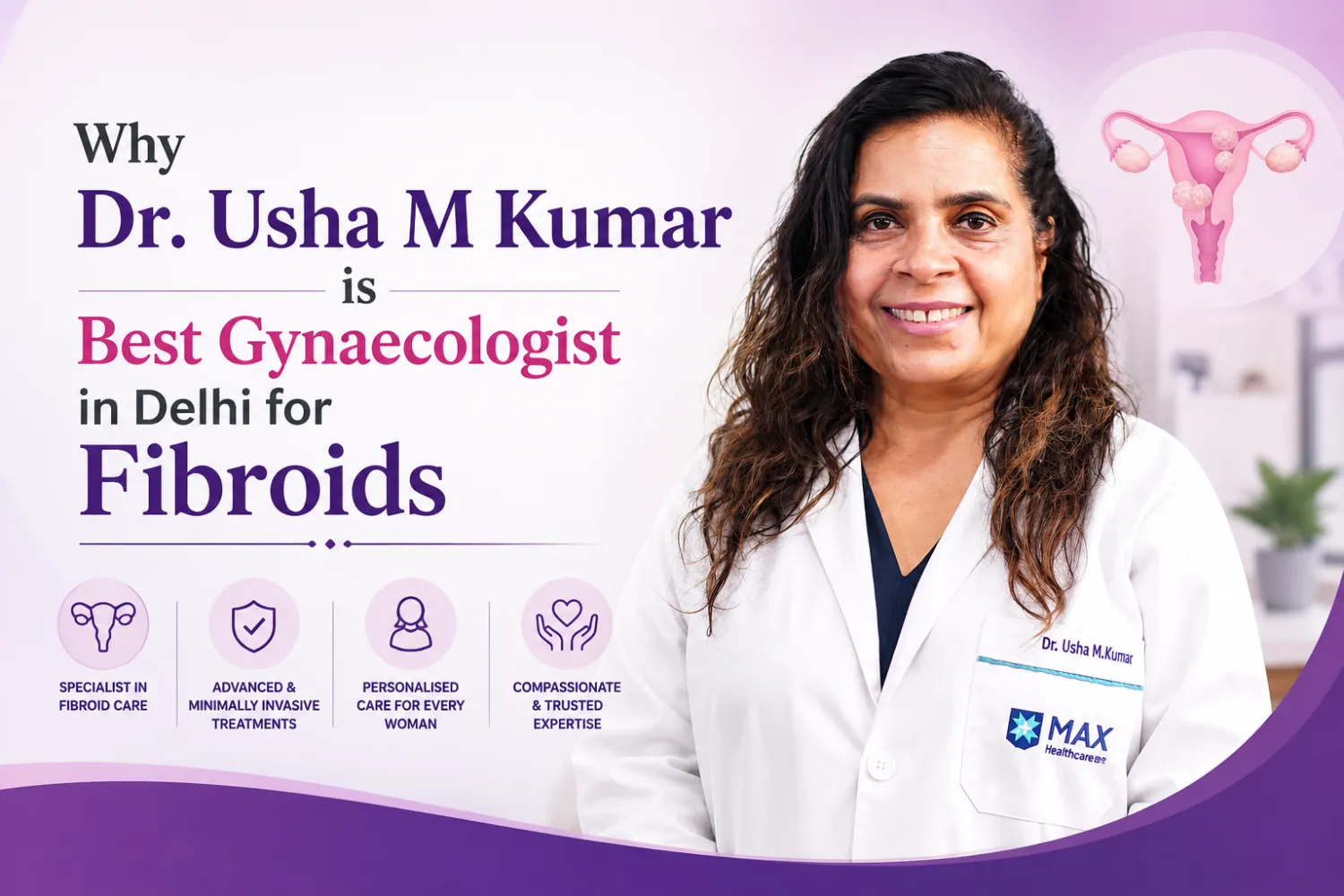
Posted By: Dr. Usha M Kumar on 24 Aug 2026
If you’ve just been told you have uterine fibroids, you’ve probably already discovered how much conflicting advice exists — one source says surgery is inevitable, another says lifestyle changes will fix everything, and a third leaves you more confused than before. When you’re searching for the best gynaecologist in Delhi for fibroids, what you actually need is a doctor whose experience allows her to cut through that noise and tell you, specifically, what your fibroids mean for your body.
This is exactly the kind of clarity Dr. Usha M Kumar, Director-level Gynaecologic & Robotic Surgeon at Max Smart Super Speciality Hospital, Saket, has built her 30+ year career around.
Fibroids Are Common — But Treatment Shouldn’t Be One-Size-Fits-All
Uterine fibroids affect a large proportion of women at some point before menopause, but no two cases are identical. A small fibroid causing no symptoms needs a completely different approach than a large submucosal fibroid causing heavy bleeding, or multiple fibroids affecting fertility in a woman trying to conceive.
This is where experience becomes the deciding factor. A gynaecologist who has managed thousands of fibroid cases over decades develops the judgment to know:
- Which fibroids genuinely need surgery, and which can be safely monitored
- Which patients are better served by a fertility-preserving myomectomy versus a hysterectomy
- When a minimally invasive (laparoscopic or robotic) approach is appropriate, and when it isn’t
- How to plan surgery around a patient’s future pregnancy goals
What Makes Dr. Usha M Kumar Stand Out for Fibroid Care
1. Three Decades of Surgical Experience
With over 30 years of experience and approximately 10,000 surgeries performed, Dr. Kumar has handled fibroid cases across the full spectrum of complexity — from single small fibroids to large multiple fibroid uteri requiring careful surgical planning. This depth of experience matters enormously in fibroid surgery, where anatomy can vary significantly from patient to patient.
2. Advanced Robotic & Laparoscopic Training
Dr. Kumar holds a Diploma in Advanced Endoscopic Surgeries from Germany and a Certificate in Laparoscopic Oncology Surgery, in addition to her MRCOG (UK) qualification. This specialised training means she’s equipped to perform laparoscopic and robotic myomectomy — procedures that remove fibroids while preserving the uterus, through small keyhole incisions rather than a large abdominal cut.
For patients, this typically translates to:
- Less blood loss during surgery
- Shorter hospital stays (often 1–2 days versus 5–7 for open surgery)
- Faster return to work and daily activities
- Smaller, less visible scarring
3. Fertility-Conscious Surgical Planning
For women who want to preserve their fertility, fibroid removal requires a surgeon skilled enough to remove fibroids thoroughly while carefully reconstructing the uterine wall to support a future healthy pregnancy. Dr. Kumar’s background managing both gynaecological surgery and reproductive health means fertility considerations are built into the surgical plan from the start, not treated as an afterthought.
4. Comprehensive, Not Just Surgical, Care
Not every fibroid needs an operation. Dr. Kumar’s consultations typically begin with a detailed diagnostic workup — ultrasound, and MRI where needed — followed by an honest conversation about whether monitoring, medical management, or surgery is the right path. This matters because unnecessary surgery is a real risk when a doctor defaults to the same solution for every patient.
5. World-Class Infrastructure at Max Smart Super Speciality Hospital
Fibroid surgery, especially robotic procedures, depends on more than surgical skill alone — it requires the right technology and a strong critical-care backup. Max Smart Super Speciality Hospital, Saket, provides Dr. Kumar with a fully equipped robotic surgery setup and multidisciplinary support, which matters if a case turns out to be more complex than initially expected.
Understanding Your Fibroid Treatment Options
When you consult Dr. Kumar for fibroids, treatment discussions generally fall into a few categories, tailored to your specific case:
Watchful waiting — For small, asymptomatic fibroids, especially in women approaching menopause (when fibroids often shrink naturally), simply monitoring with periodic scans may be the most sensible option.
Medical management — Hormonal treatments can help manage heavy bleeding and pain for women with mild-to-moderate symptoms who wish to avoid or delay surgery.
Laparoscopic/robotic myomectomy — Fibroid removal with uterus preservation, generally recommended for women who want to retain fertility or simply keep their uterus.
Hysteroscopic myomectomy — For fibroids inside the uterine cavity (submucosal), removed through the cervix with no external incision at all.
Robotic or laparoscopic hysterectomy — Considered for women with severe, recurrent symptoms who have completed their family or do not wish to preserve the uterus.
What Patients Can Expect From a Consultation
A first consultation with Dr. Kumar for fibroids typically involves:
- A detailed history of your symptoms and menstrual pattern
- Physical examination and review of prior scans, if available
- Ultrasound (and MRI if the case requires more detailed mapping)
- A clear explanation of what type of fibroid(s) you have and where they’re located
- An honest, personalised discussion of your options — including the pros, cons, and recovery expectations of each
Patients frequently describe her approach as unhurried and thorough — an important quality for a diagnosis that can feel overwhelming on first hearing it.
Frequently Asked Questions About Fibroid Treatment
Do all fibroids need surgery? No. Many small, asymptomatic fibroids are simply monitored. Surgery is generally considered when fibroids cause significant symptoms, affect fertility, or grow substantially.
Can I still have children after fibroid surgery? In many cases, yes — myomectomy is specifically designed to preserve the uterus and fertility. Your surgeon will assess your specific case to advise on the best approach and appropriate waiting period before attempting pregnancy.
How long is recovery after robotic fibroid surgery? Recovery is generally faster than open surgery — many patients return to light activity within a week or two and to full activity within 3–4 weeks, though this varies by individual and the extent of surgery.
Will fibroids come back after surgery? New fibroids can develop over time, particularly in younger women, though this varies. Your gynaecologist can advise on monitoring after surgery based on your individual risk factors.
Book a Consultation With Dr. Usha M Kumar
If you’re searching for the best gynaecologist in Delhi for fibroids, Dr. Usha M Kumar brings the surgical experience, advanced robotic training, and patient-centred approach that fibroid care demands. She consults at Max Smart Super Speciality Hospital, Saket, and welcomes patients seeking both a second opinion and first-time evaluation.
Book an appointment with Dr. Usha M Kumar to discuss your fibroid diagnosis and the treatment path best suited to you.