




Posted By: Dr. Usha M Kumar on 23 Nov 2026
You wake up at 3 a.m. drenched in sweat, though the room is cool. Your period, which used to arrive like clockwork, now comes twice in one month, or skips two. You snap at people you love, forget words in the middle of a sentence, and wonder whether something is wrong with you.
In most cases, nothing is “wrong”. You may simply be in perimenopause, the transition before menopause, and it affects almost every woman. Yet many women in their forties and fifties put up with it silently, assuming it is something to endure. It does not have to be. This guide explains the common perimenopause symptoms, why heavy bleeding needs special attention, and what treatment options exist, including hormone therapy.
Perimenopause and menopause: what is the difference?
Perimenopause is the stage, often lasting several years, when your hormone levels begin to fluctuate and your periods become less predictable. It usually begins in the mid-to-late forties, but can start earlier.
Menopause is a single point in time: it is confirmed when you have gone twelve months in a row without a period, with no other cause. In India, the average age is in the late forties, though it varies from woman to woman.
Postmenopause is everything after that point.
The symptoms most women find troublesome tend to happen in perimenopause and the first few years after menopause, which is when hormone levels are at their most unsteady.
Common perimenopause symptoms
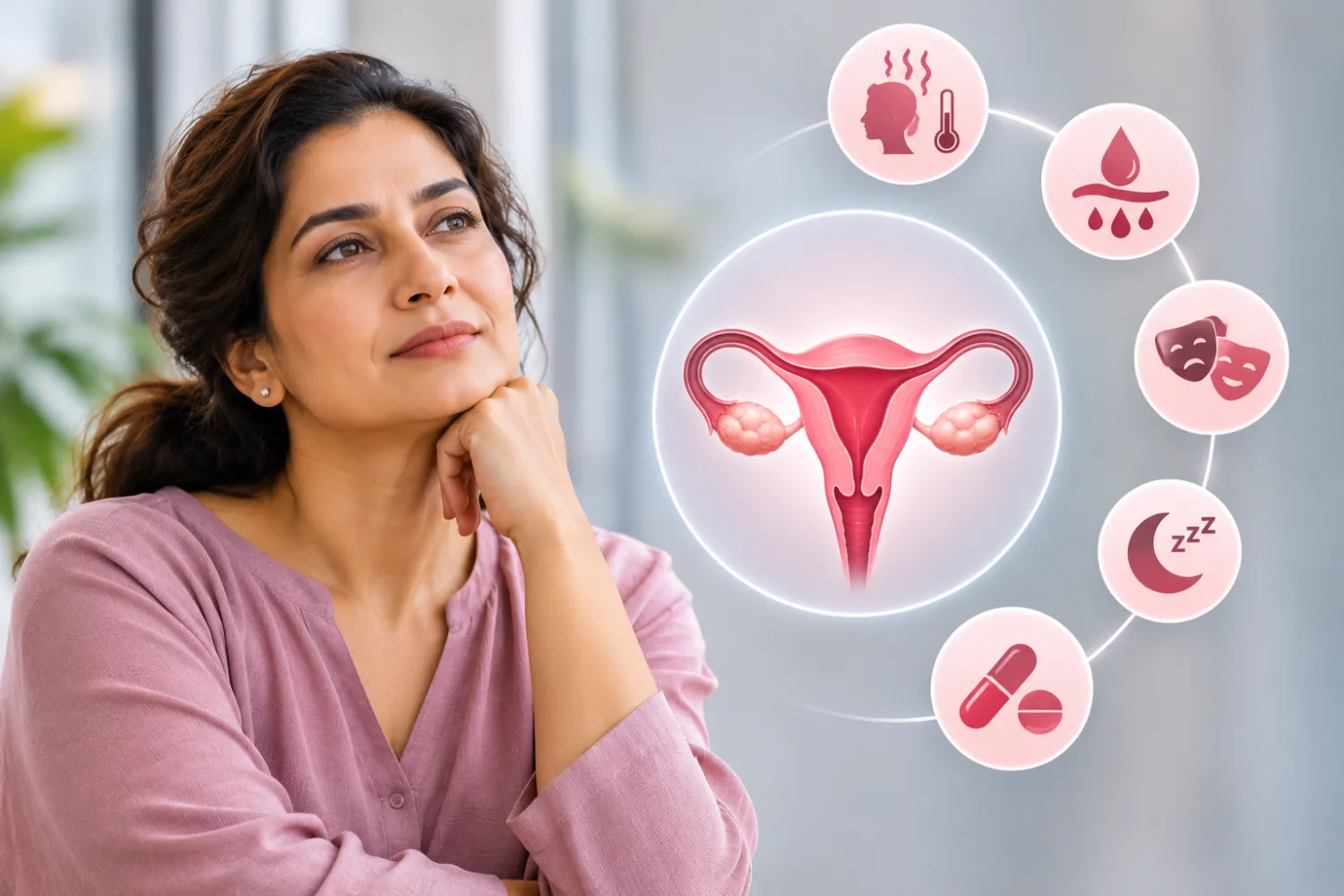
No two women have exactly the same experience. Some sail through with mild changes, while others find daily life affected. Common symptoms include:
- Changes in your periods: shorter or longer cycles, lighter or heavier flow, skipped months.
- Hot flushes and night sweats: sudden waves of heat, often with sweating and a racing heart.
- Sleep problems: difficulty falling or staying asleep, sometimes because of night sweats and sometimes independent of them.
- Mood changes: irritability, low mood, anxiety or feeling “not like yourself”.
- Brain fog: trouble concentrating or remembering things.
- Vaginal dryness and discomfort, including pain during sex and recurrent urinary infections or urgency.
- Lower sex drive.
- Joint aches and stiffness.
- Weight changes, particularly around the waist.
- Palpitations and headaches, which should still be checked by a doctor to be sure nothing else is going on.
It is easy to blame these on stress or work pressure, especially in busy professional years. But if they are affecting your sleep, work or relationships, they deserve proper attention.
Heavy bleeding: when it is more than “just perimenopause”
Irregular periods are expected in perimenopause. Heavy bleeding, however, should not simply be accepted, and it is one of the main reasons women see a gynaecologist at this stage.
See a doctor if you have:
- Bleeding that soaks through a pad or tampon every hour or two
- Passing large clots
- Periods lasting much longer than seven days
- Bleeding between periods or after sex
- Periods that come more often than every 21 days
- Tiredness, breathlessness, dizziness or pale skin, which can be signs of anaemia
- Any bleeding after menopause. Bleeding after twelve months without a period always needs to be checked promptly.
There are several possible causes of heavy bleeding at this age, and hormonal changes are only one. Others include fibroids, polyps, adenomyosis, thickening of the womb lining, thyroid disorders and, less commonly, cancer. Because the possibilities are so different, it is worth identifying the cause rather than guessing. You can read more about fibroids in our guide to fibroids and heavy periods.
How heavy bleeding is evaluated
Your gynaecologist may suggest:
- A blood count to check for anaemia, and sometimes thyroid tests
- A pelvic ultrasound to look at the uterus, ovaries and womb lining
- A hysteroscopy, where a thin camera looks inside the womb, sometimes with a small sample (biopsy) taken from the lining. Our page on hysteroscopy explains how this works.
A biopsy of the womb lining is particularly relevant for women over 45 with heavy or irregular bleeding, or at any age if bleeding persists despite treatment. It is a precaution to rule out abnormal changes and is not a cause for alarm in itself.
Treatment options for heavy bleeding
Depending on the cause, your options may include:
- Tranexamic acid, a tablet taken during periods to reduce bleeding
- Hormonal treatment, such as progestogen tablets or a hormone-releasing intrauterine system (a small coil placed inside the womb)
- Iron supplements to correct anaemia
- Removal of polyps or fibroids, often through a keyhole or hysteroscopic procedure
- Surgery, including hysterectomy, for women whose bleeding does not respond to other treatment or who have a condition that needs it. If you are advised to have surgery, our article on getting a second opinion before a hysterectomy can help you ask the right questions.
Hormone therapy: what you should know
Menopausal hormone therapy (often called HRT) replaces some of the oestrogen that your body is making less of. It is probably the most discussed, and most misunderstood, part of menopause care.
What it can help with
Hormone therapy is the most effective treatment for hot flushes and night sweats. It can also improve sleep, mood in some women, vaginal dryness and the long-term loss of bone density that follows menopause.
Types of hormone therapy
- Oestrogen with a progestogen: for women who still have a uterus. The progestogen protects the womb lining, because oestrogen alone can cause it to thicken.
- Oestrogen alone: for women who have had their uterus removed.
- Local (vaginal) oestrogen: low-dose creams, tablets or rings that treat vaginal dryness and urinary symptoms with very little absorption into the rest of the body.
- Different delivery forms: tablets, skin patches, gels or sprays. Your doctor will help you choose.
Is it safe?
For many healthy women, hormone therapy started around the time of menopause, usually before sixty or within ten years of the last period, offers benefits that outweigh risks. But it is not right for everyone. It is generally avoided or used with great care in women with a history of breast cancer, certain other hormone-sensitive cancers, unexplained vaginal bleeding, active liver disease, or a history of blood clots or stroke. Risks and benefits depend on your age, health, family history and the type of therapy, which is why it should be an individual decision with your doctor, not a blanket yes or no. Treatment is usually reviewed regularly rather than continued indefinitely by default.
Treatments that do not involve hormones
If hormone therapy is not suitable, or you would rather avoid it, other options exist.
- Lifestyle measures: regular exercise, a balanced diet with enough calcium and protein, limiting caffeine and alcohol, wearing layers, keeping the bedroom cool and avoiding known triggers for hot flushes.
- Non-hormonal medicines: some prescription medicines can reduce hot flushes. Your doctor can advise which are suitable.
- Vaginal moisturisers and lubricants for dryness.
- Cognitive behavioural therapy and relaxation techniques, which can help with sleep, mood and coping with symptoms.
- Strength training and weight-bearing exercise to protect bones and muscle.
Be cautious about unregulated supplements and “natural” remedies promoted online, as evidence for many is limited and some interact with other medicines.
Looking after your long-term health
Menopause is also a good moment to check in on your overall health, because the fall in oestrogen affects bones, heart health and cholesterol. A review at this stage often includes blood pressure, blood sugar, cholesterol, thyroid and vitamin levels, breast and cervical screening, and a discussion of bone density. We explain which tests matter in our guide to the annual health check for women over 40.
When to see a gynaecologist
Book a visit if:
- Your periods are very heavy, last long or come too often
- You bleed between periods, after sex or after menopause
- Hot flushes, sleep problems or mood changes are affecting daily life
- Vaginal dryness or pain is affecting your comfort or relationships
- You feel anxious or low for more than a couple of weeks
- You are unsure whether your symptoms are menopause or something else
If travelling is difficult, you can start with a telephone or video consultation and plan tests from there.
Frequently asked questions
At what age does perimenopause begin? For most women, in the mid-to-late forties, though it can start earlier.
How long does perimenopause last? Often several years, but this varies widely.
Can I still get pregnant during perimenopause? Yes. Ovulation becomes unpredictable but does not stop immediately, so contraception is still needed if you do not want a pregnancy.
Is heavy bleeding normal at menopause? It is common in perimenopause but should still be checked. Bleeding after menopause is never to be ignored.
Is hormone therapy dangerous? Not for everyone. It is safe and helpful for many women when started appropriately, but the right decision depends on your health.
Will I need to take hormones forever? No. Treatment is reviewed regularly, and many women use it for a limited period.
You do not have to just put up with it
Menopause is a natural stage of life, but struggling through it in silence is not. If your symptoms are bothering you, Dr. Usha M Kumar, with more than 30 years of experience in women’s health, can help you understand what is happening and choose treatment that suits you. You can read about Dr. Usha, then book an appointment or contact the clinic.
Disclaimer: This article is for general information and does not replace a personal medical consultation. Hormone therapy should only be started or stopped under medical supervision.