




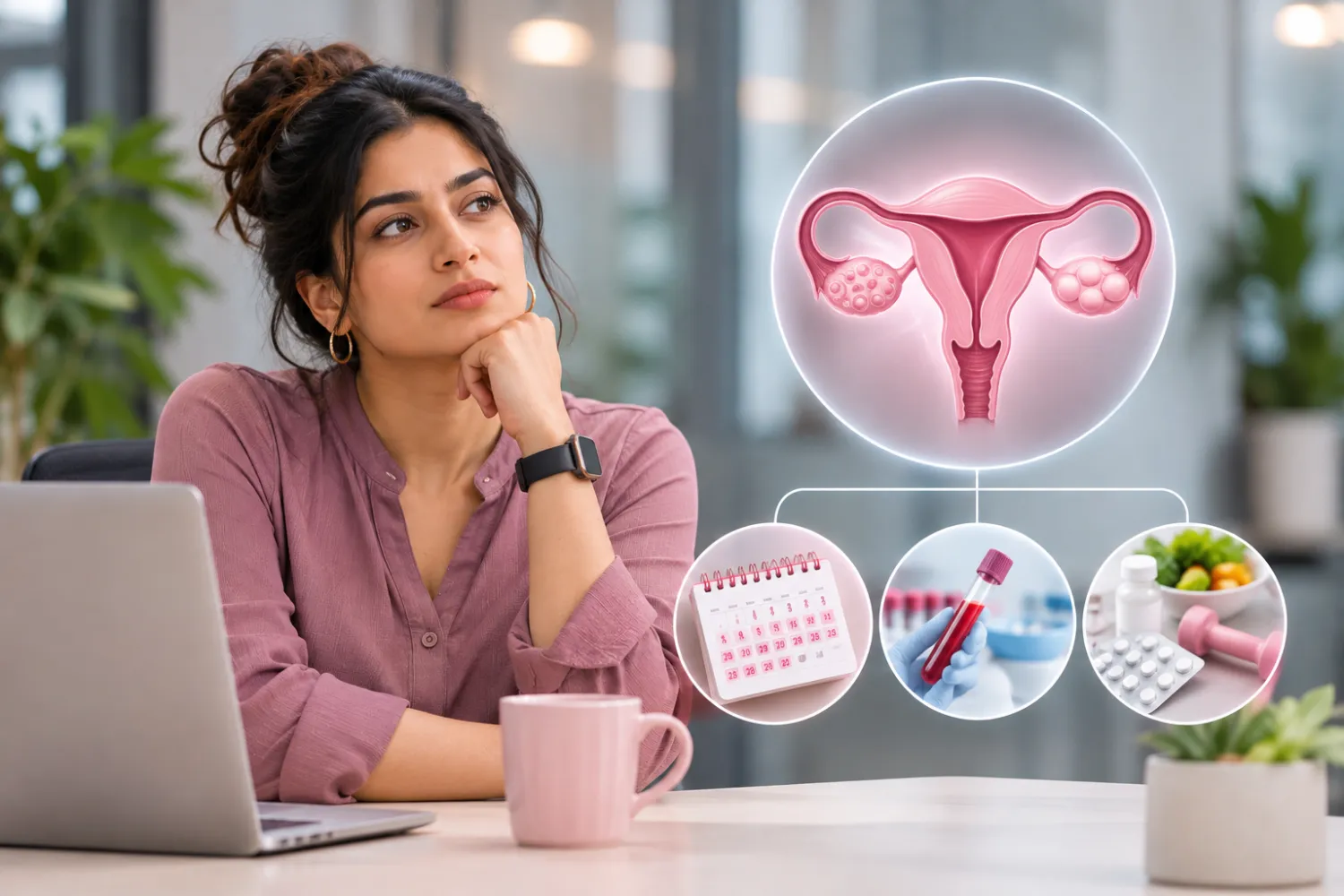
Posted By: Dr. Usha M Kumar on 12 Nov 2026
You are 27, working long hours, and your periods have started arriving whenever they feel like it. Maybe every two months, maybe every four. You have also noticed more acne than you had in college, a few extra kilos that won’t budge, and hair in places you didn’t expect. Your friends say it’s stress. Your mother says it’s the office food. Somewhere on the internet, you saw three letters: PCOS.
You are not alone. Polycystic ovary syndrome is one of the most common hormonal conditions in women of reproductive age, and many women in Delhi’s busy offices and workplaces live with it for years before getting a proper diagnosis. This guide covers the main PCOS symptoms and treatment options, the tests doctors use, and when it is worth seeing a gynaecologist.
What is PCOS?
PCOS is a hormonal and metabolic condition. In simple terms, the ovaries and the hormone system that controls them are not working in their usual rhythm. Ovulation (the monthly release of an egg) becomes irregular or stops, and levels of androgens, sometimes called “male hormones” that all women have in small amounts, can run higher than usual. Many women with PCOS also have insulin resistance, meaning the body needs more insulin than normal to manage blood sugar.
The name is slightly misleading. You do not need to have “cysts” in the ovaries to have PCOS, and having small follicles on an ultrasound does not on its own mean you have it. Doctors look at the whole picture.
Common PCOS symptoms
PCOS looks different in different women. Some have all of the signs below, others only one or two.
- Irregular periods: cycles longer than 35 days, fewer than eight or nine periods a year, or long gaps with no period at all.
- Excess hair growth (hirsutism): on the face, chin, chest or abdomen.
- Acne or oily skin, especially along the jawline, that does not respond well to usual treatment.
- Scalp hair thinning in a pattern similar to male-pattern hair loss.
- Weight gain, particularly around the abdomen, or difficulty losing weight.
- Darkened patches of skin on the neck, underarms or groin, which can signal insulin resistance.
- Difficulty getting pregnant, because ovulation is irregular.
- Low mood, anxiety and fatigue. These are common and are not “just in your head”.
If several of these sound familiar, it is worth a proper check rather than waiting and hoping things settle.
Why do so many working women notice it late?
Irregular periods are easy to excuse in a demanding job. Long hours, disturbed sleep, skipped meals, travel and stress can all disturb a cycle, so women often assume that is the whole story. Add the fact that heavy periods and period problems are not discussed openly at most workplaces, and it is no surprise that many women wait years.
But there is a reason not to wait. Untreated PCOS can affect more than periods. Over time it is linked to a higher risk of type 2 diabetes, high blood pressure, raised cholesterol, sleep apnoea and, when periods are very infrequent, thickening of the womb lining. It can also make conceiving harder, though most women with PCOS can have children with the right support.
How is PCOS diagnosed?
There is no single test for PCOS. Doctors usually diagnose it when at least two of these three features are present, after other causes have been ruled out:
- Irregular or absent ovulation, usually seen as irregular periods
- Signs of high androgens, either on examination (acne, hair growth) or on blood tests
- Polycystic-appearing ovaries on ultrasound
Here is what a typical assessment involves.
A detailed history and examination. Your gynaecologist will ask about your periods, weight changes, skin and hair, family history of diabetes or PCOS, and any plans for pregnancy. Blood pressure, weight and waist measurements are usually recorded.
Blood tests. These commonly include hormone tests such as testosterone, as well as thyroid function and prolactin, because thyroid problems and high prolactin can mimic PCOS. Blood sugar or HbA1c and a cholesterol profile are often added, since PCOS is tied to metabolic risk. Your doctor may order others depending on your symptoms.
A pelvic ultrasound. This checks the ovaries and the lining of the womb. For unmarried women, an abdominal scan or other approach may be used, and your doctor will explain what is suitable.
It is worth knowing that AMH, a blood test that reflects ovarian reserve, is often higher in women with PCOS. If you have seen your AMH result, ask your doctor to interpret it in context, rather than reading too much into the number alone.
PCOS treatment: what actually helps
Treatment is tailored to what bothers you most and whether you want to become pregnant now or later. There is no single “cure”, but the symptoms can be managed very well.
Lifestyle changes
This is the foundation of treatment, and it does not mean crash diets. Even a modest weight loss of about five to ten per cent of body weight, for women who are overweight, can help restore regular ovulation and improve insulin sensitivity. Practical steps include regular physical activity (a brisk walk most days is a good start), meals that are rich in fibre and protein and lower in refined carbohydrates and sugary drinks, and a steady sleep routine. Working women often do best with small, realistic changes rather than strict plans they cannot keep up.
Medicines for cycles and skin
If you are not trying to conceive, hormonal treatment such as a combined oral contraceptive pill can regulate your periods, protect the womb lining and improve acne and excess hair. Anti-androgen medicines are sometimes added for stubborn hair and acne. These are prescription medicines, and the right choice depends on your health history, so please do not start them without medical advice.
Medicines for insulin resistance
In some women, a doctor may prescribe metformin to improve how the body handles insulin, especially when blood sugar is borderline or there is a strong metabolic component.
Help with ovulation and fertility
If you want to get pregnant, medicines that trigger ovulation can be used under supervision. For women who do not respond to medicines, surgical or assisted options may be considered, and your doctor will talk you through the choices. Early planning helps, so if you are thinking about pregnancy in the next year or two, mention it at your first visit.
Emotional wellbeing
PCOS can affect self-esteem, body image and mood. If you are feeling low or anxious, tell your doctor. This is part of the condition, not a personal failing, and support is available.
When should you see a gynaecologist?
Book an appointment if:
- Your periods are regularly more than 35 days apart, or you go months without one
- You have not had a period for three months and are not pregnant
- You have new acne, hair growth or hair thinning that bothers you
- You are trying to conceive and have not been able to after several months of trying, or sooner if your cycles are irregular
- You have heavy bleeding with irregular cycles. In some cases this needs a closer look at the womb lining, and our article on fibroids and heavy periods explains other causes worth ruling out
Severe pelvic pain, especially around periods, is not typical of PCOS alone and may point to another condition such as endometriosis. Read more in our guide to endometriosis in young women.
Can you get checked without disrupting work?
Yes. Many women find the biggest barrier is time. A first discussion can often be done through a telephone or video consultation, after which tests and a scan can be planned at a time that suits you. Employers who want to support their teams can also look at the corporate well-women health programme, which includes awareness and screening for conditions like PCOS.
Frequently asked questions
Can PCOS be cured? Not permanently, but it can be managed very effectively. Symptoms often improve with lifestyle changes and treatment.
Can I get pregnant with PCOS? Many women with PCOS conceive, sometimes naturally and sometimes with medical help. Seeing a doctor early makes planning easier.
Do I need to lose weight to treat PCOS? Weight loss helps some women a great deal, but PCOS also occurs in women of normal weight. Treatment should be based on your own situation.
Is PCOS the same as having ovarian cysts? No. The small follicles seen on ultrasound are not the same as ovarian cysts that may need treatment.
Will PCOS go away after marriage or pregnancy? No. This is a common myth. PCOS needs ongoing attention, though symptoms may change over time.
Talk to a specialist
If you recognise yourself in this article, a conversation with a gynaecologist can bring clarity and a clear plan. Dr. Usha M Kumar has more than 30 years of experience in women’s health. You can read more about Dr. Usha, then book an appointment.
Disclaimer: This article is for general information and does not replace a personal medical consultation. Please do not start or stop any medicine without advice from your doctor.